Physics
Pathology
Resources
Magnetic Resonance Imaging (MRI)
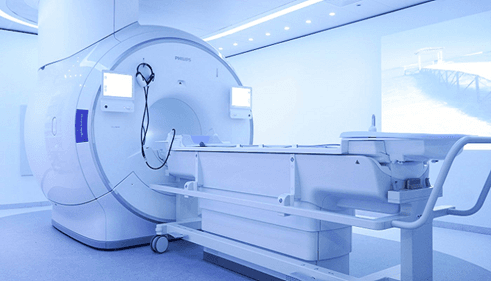
Magnetic Resonance Imaging (MRI) is a non-invasive medical imaging technique that utilizes strong magnetic fields and radio waves to produce detailed images of internal body structures without using ionizing radiation. MRI is highly effective in visualizing soft tissues such as the brain, muscles, internal organs, and blood vessels.
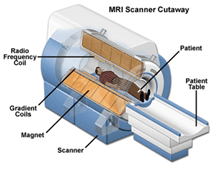
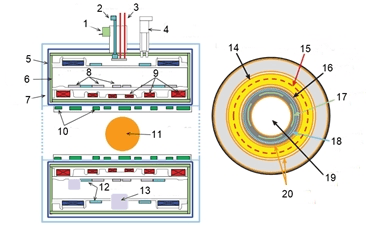
The working principle of MRI is based on the phenomenon of Nuclear Magnetic Resonance (NMR), which involves the interaction between magnetic fields, radio waves, and hydrogen atom nuclei (protons) in the human body. Protons in hydrogen nuclei have a spin property, which is an intrinsic angular momentum that creates a small magnetic field. When a patient's body is placed in a strong static magnetic field—generated by a superconducting magnet with a strength between 1.5 to 7 Tesla (T)—protons in the body will align parallel or antiparallel to that magnetic field.
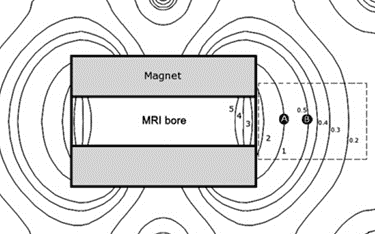
Larmor Frequency & Imaging Process
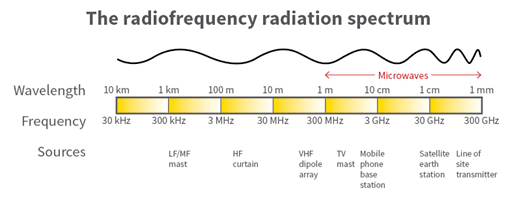
Protons resonate at a specific frequency called the Larmor frequency, which depends on the magnetic field strength and magnetic properties of the protons. The imaging process begins when radiofrequency (RF) waves with the same frequency as the Larmor frequency are applied to the patient's body.
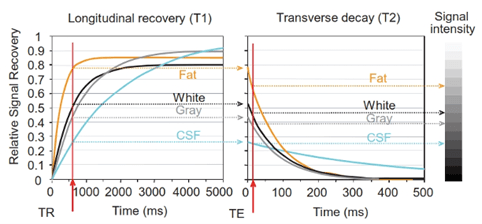
T1 and T2 Relaxation
- T1 Relaxation (Longitudinal): The time required for protons to realign with the main magnetic field.
- T2 Relaxation (Transversal): The decay of transverse magnetization signal due to proton-proton interactions.
Differences in T1 and T2 relaxation times in various body tissues enable high contrast between soft tissues in MRI images.
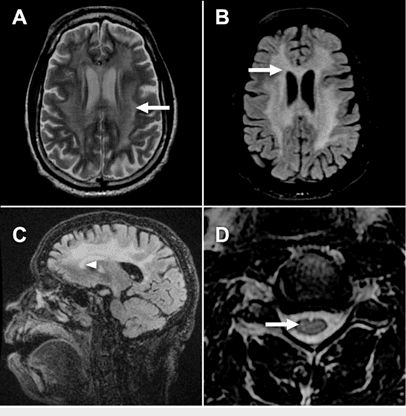
MRI System Components
Advantages
- No ionizing radiation (safe for repeated examinations).
- Superior soft tissue contrast.
- Multi-planar visualization (axial, sagittal, coronal).
Limitations
- High cost and longer scan time.
- Contraindicated for metal implants/pacemakers.
- Less effective for hard bone tissue.